Trampler Editor Guide
The Trampler Editor matters because the Trampler is the crew's mobile base, storage logic, combat platform, and extraction insurance. A good build supports the route you actually play, not the fantasy fight you imagine before loading in.
Official descriptions position the Trampler as a highly customizable walking mech fortress. That means build quality is not only about raw firepower. It is about whether the layout helps the crew move, store loot, survive contact, and extract when the run is already good enough.
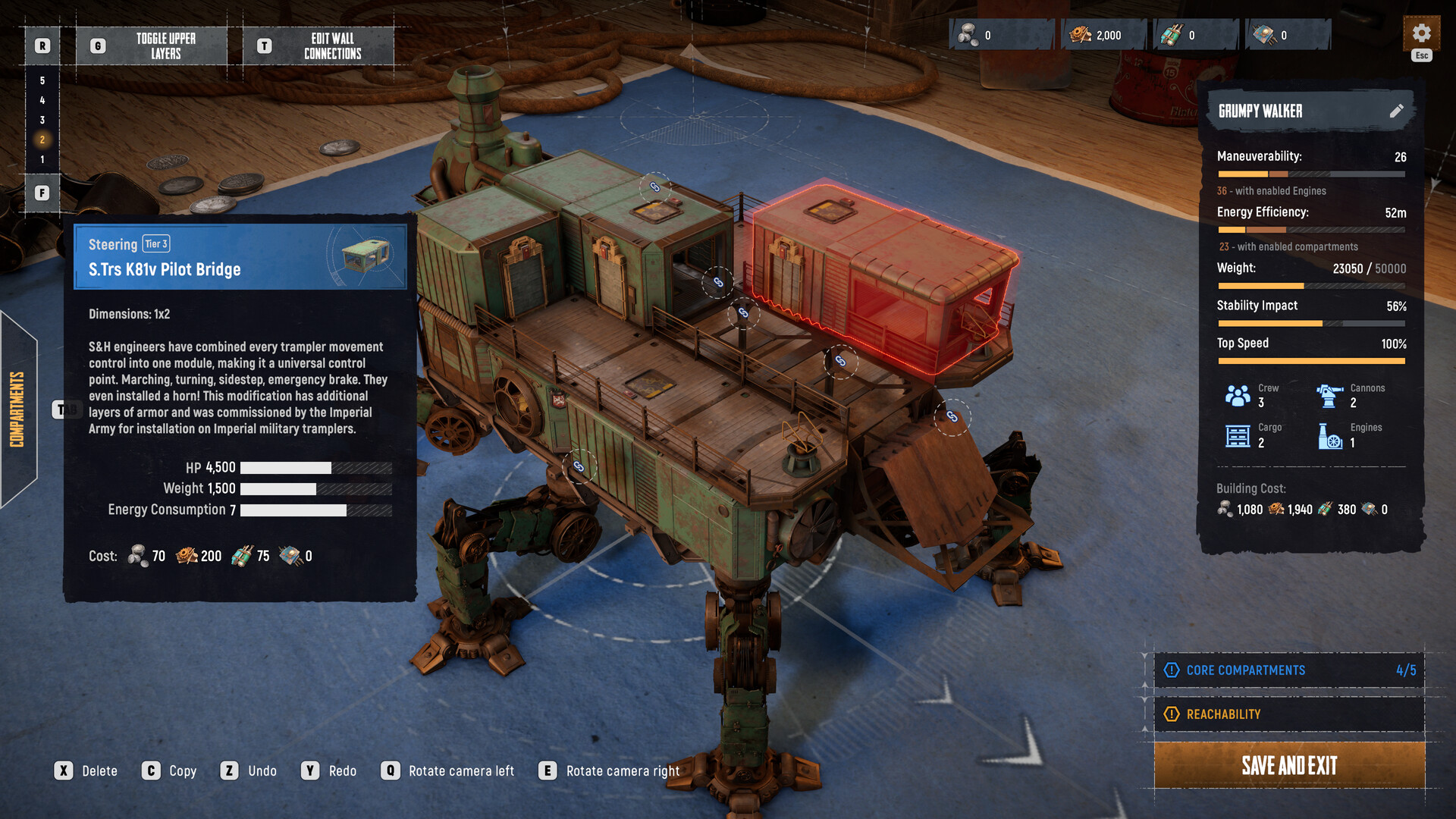
Named editor information visible in official media
| Field | Visible value | Why it matters |
|---|---|---|
| Component | S.Trs K81v Pilot Bridge, Steering Tier 3 | This is a named control compartment, not a generic “driver room.” |
| Dimensions | 1×2 | Footprint affects wall connections, deck traffic, and where the bridge can fit. |
| Durability | 4,500 HP | The published UI provides a concrete durability value for this component in the captured build. |
| Weight | 1,500 | Component weight contributes to the build-level weight and stability calculation shown on the right. |
| Energy use | 7 | The editor exposes energy consumption before deployment. |
| Validation | Core compartments 4/5; reachability warning | A blueprint can be structurally present yet still fail a required-compartment or access check. |
Current patch notes that affect blueprints
- Update #3 (July 10): added the Crow's Nest compartment and fixed black baked shadows in some compartments.
- Update #4 (July 14): Crow's Nest now requires support. Blueprints that violate the new rule are automatically sold and their resources returned.
- July 18: fixed the first Trampler level appearing black in the editor and listed the S. Trs Entrance Vestibule blueprint-save problem as a current issue.
- July 17 Q&A: all Tramplers currently share the same top speed on flat terrain; maneuverability controls turning and acceleration, and helps smaller builds on rough ground.
Trampler Component Calculator
Copy component values directly from your in-game editor. The calculator totals weight, energy use, durability, and occupied grid cells without inventing unpublished module statistics. Entries stay in this browser.
Components0
Total weight0
Total energy0
Total HP0
Grid cells0
| Component | Weight | Energy | HP | Size |
|---|
Core Room Planning
Exact balance can change during Early Access, so plan around jobs rather than fixed meta numbers. Every room or component should answer a route problem.
Build around a job
Editor Planning Table
| System | Question to answer | Good beginner choice | Bad sign |
|---|---|---|---|
| Engine / movement | Can the Trampler reposition before the crew is trapped? | Prioritize readable movement and reliable retreat paths. | The build wins fights only when parked perfectly. |
| Storage | Can loot move from entry to storage without blocking combat flow? | Place storage near the return path but not in the driver's way. | Players sort loot while standing in the main traffic lane. |
| Crew rooms | Does the layout match solo, duo, or larger crew behavior? | Enough role space for the actual crew size, not a fantasy group. | Six players have rooms but no assigned jobs. |
| Weapons | Do mounted guns protect exits and storage transfer? | Cover retreat angles and discourage pushes. | Weapons face a direction the route rarely uses. |
| Recovery / support | What happens after the first mistake? | Keep support access easy when the crew is retreating. | Recovery tools sit behind clutter or a long internal walk. |
First Build Recommendation
For a first build, choose stability over specialization: enough mobility to leave, enough storage to make a short run pay, and enough defensive thinking to discourage one bad chase. Extreme builds can wait until the crew understands where they fail.
- Keep the route short: build for a clean loop before building for a deep push.
- Protect the storage path: players carrying value should not have to cross the most exposed or confusing part of the Trampler.
- Keep exits readable: if a new player cannot tell where to regroup, the layout is too clever.
- Use weapons defensively: mounted firepower should buy time to reposition, not tempt the crew into every fight.
Build Test Plan
- Run the build in Voyage Mode before taking it into higher-pressure routes.
- Check whether the Trampler can turn around, protect storage, and support a retreat.
- Ask each crew member what they do when contact starts.
- Practice the boring failure case: low supplies, one valuable pickup, enemy contact, and a forced exit.
- Remove any room or part that looks impressive but does not solve a route problem.
Layout Mistakes to Avoid
Solo vs Crew Build Thinking
Solo builds should be readable and forgiving. You cannot rely on another player to cover an angle, move loot, or call exit while you drive. Crew builds can specialize more, but only if each player knows their job before contact starts.
For teams, the official support FAQ lists a maximum crew size of 6 and notes that larger teams should have enough crew rooms on the Trampler. Treat that as a planning reminder: crew size is not just a matchmaking number; it changes how much space, role clarity, and route discipline your build needs.
Next Pages
Pair this page with crew and server limits, verified weapon values, extraction planning, and the current issues list.
Direct official sources
- Steam store page and official editor screenshot.
- Update #3 — Crow's Nest and editor fixes.
- Update #4 — support requirement and moving-Trampler interaction fixes.
- July 17 Community Q&A — maneuverability, top speed, and future compartments.
- July 18 anti-cheat update — editor fix and current blueprint issue.